



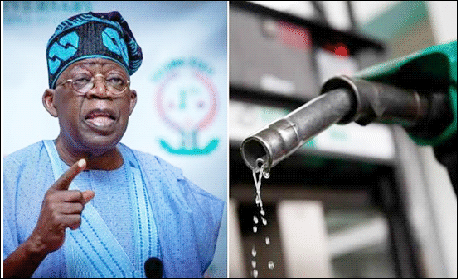
President Bola Tinubu’s petronomics has come full circle — from the triumphant “subsidy is gone” on May 29, 2023, to the quiet reintroduction of a ”30-day margin discount” at NNPC stations this October. Call it a discount, call it selling at cost, call it a landing-cost ceiling of N1, 350. Nigerians know what it is: a subsidy by another name but clothed in politics. Or how else can one explain this mini somersault a few months to the General Elections? But one thing sticks out like a sore thumb: it is the most damning admission yet, that Tinubu’s policy has failed.
For three years, Nigerians were told to endure the pain. Fuel moved from N197 to N1, 500 per litre. Transport fares tripled. Food inflation became unbearable. Small businesses powered by petrol generators collapsed. The administration called it medicine, called the subsidy a cancer, called Nigerians addicted to morphine. We were told the market would correct itself, that Dangote Refinery, CNG buses and improved forex would bring relief.
None of it happened. Or more accurately, it happened too little, too late, and too unevenly.
Now, on the eve of an election cycle, the government that vowed never to return to the “ruinous” regime has announced what Finance Minister, Taiwo Oyedele, insists is not a subsidy: a 30-day fuel price cut at NNPC retail outlets, with priority for public transporters. If it is not a subsidy, why does it need to be negotiated? Why does it need to be limited to 30 days? Why only at NNPC Stations?
This little subsidy is ineffective by design.
First, it is tokenist. A 30-day relief cannot undo three years of erosion. The Social Democratic Party rightly called it palliative governance. It does not address crude pricing, refining capacity, FX exposure, or NNPC’s opaque landing costs. It only suppresses the pump price at a few hundred stations while private marketers continue to sell at N1, 370-N1, 500.
Second, it creates the worst of both worlds: it retains the fiscal burden of subsidy without its universal benefit. The government will absorb the margin, NNPC will bleed, and scarcity will return as marketers divert products to where they can get full margin. We have seen this movie before.
Third, it destroys credibility. Tinubu told the nation on October 1st that Nigeria had passed through its own Red Sea and must not look back. One week later, he looked back. Investors who priced in full deregulation now, have to price in political reversal. Households who bought CNG kits on the promise of a permanent transition now see that petrol pricing is still a political instrument.
Poor petronomics is not about removing or keeping subsidy. It is about incoherence. You cannot liberalize prices without liberalizing supply. You cannot float the Naira, devalue purchasing power by 70%, and expect a petrol price, determined in dollars to stay affordable. You cannot claim N6 billion in non-oil exports while your entire transport economy still runs on imported petrol.
If the subsidy was a cancer, this discount is a painkiller, applied after three years of chemotherapy that killed the patient but not the cancer. It confirms what critics warned: you cannot reform by declaration alone.
What Nigeria needs is not a little subsidy or a big subsidy, but an honest petronomics — fix the refineries and make them accountable, publish the real landing cost and NNPC’s books, expand CNG beyond 120, 000 vehicles in a country of 40 million vehicles, and provide targeted cash transfers that actually reach the vulnerable.
Until then, this 30-day discount will expire, prices will jump again, and Nigerians will be left exactly where they started — paying the price for a reform that never had a plan. And to us, this looks like a ploy to give Nigerians a false hope. It is also like pushing up a drowning man to breathe some air, before pushing him back down. And that is the greatest deception of all time.