



By Fr. Pat. Amobi Chukwuma
Many years ago as a boy, I was staying with my biological father in his shop situated at Ahmadu Bello Way, Jos, in Plateau State. My father was dealing in textiles. He travelled to Onitsha Main Market frequently, to purchase goods. One day, two of us were in the shop when a customer came in to buy some wrappers. By then, five Naira note was big money. The customer paid with the five Naira currency and was to be given change. Unfortunately, we had no change in our drawer. Hence my father sent me out to look for change.
I was moving from one shop to the other asking for the change without success. Suddenly one big boy came along as I was holding the five Naira note upwards. He quickly snatched it from me and ran away. I pursued him, shouting, “Barawo! Barawo!! Barawo!!!”(Thief!). Despite the speed of motorists on both lanes of the tarred road, he crossed dangerously. Because life has no duplicate, I waited for some minutes before crossing. By then the visible snatcher had disappeared into oblivion.
I went back to our shop in tears. My dad who was waiting anxiously asked me what was wrong and why the long delay. I sorrowfully told him that one big boy snatched the money from my hands and disappeared. My dad sighed. Throughout that fateful day I was daydreaming about the visible snatcher.
Everything has an opposite. The opposite of God is Satan. The opposite of day is night. The opposite of security is insecurity. The opposite of life is death. The opposite of heaven is hell. Thus, the opposite of visible snatcher is invisible snatcher.
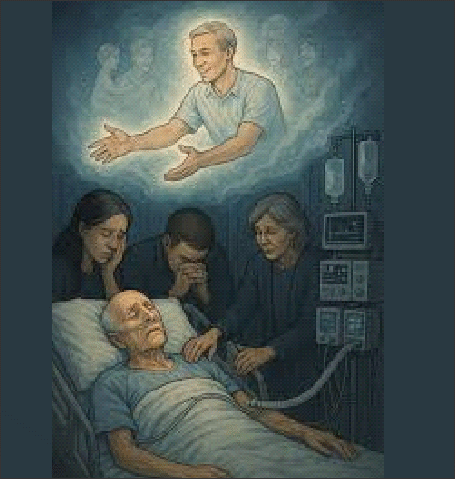
Who is this invisible snatcher? Is it a male or a female? Without further delay the invisible snatcher is Death. It is genderless. It came into existence after the unfortunate fall of man from grace to grass at the Garden of Eden. It has no respect and comes suddenly to snatch its victim. Science and technology have tried to develop something that would conquer death, but all to no avail.
The fear of death is the biggest challenge faced by all mortals, especially human beings. A certain billionaire was diagnosed with a terminal illness. His doctor told him boldly that death was coming soon to snatch him. The billionaire shouted, “What? I must try by all means to prevent him.” He hired six fierce looking soldiers with Ak-99 to keep watch around his sick-bed. He also brought strong magicians and popular native doctors who kept performing some rituals against death.
As a last resort, he wrote a cheque and kept it at his bedside. On the cheque he wrote, “Pay Mr. Death the sum of five million Naira”. After all these precautions, death came unawares and snatched him. As he was breathing his last, he was crying and shouting, “Had I known!” At last he died. His wife mourned greatly. She angrily drove away the fierce soldiers, magicians and native doctors for their incapability to wade off the death of her beloved and wealthy husband.
Human life begins at conception when the male sperm fertilizes the female egg. The product of the fertilization is called fetus, which is naturally transported to the woman’s womb for subsequent development within nine months. Birth comes after. Morally speaking, human life begins at conception and not at birth. The newly born is fed with the mother’s breast milk for some months before it can drink any other liquid and eat solid food. The baby crawls, stands and walks as time goes on.
Human life right from conception has no guarantee. The invisible snatcher called death can claim it at any given time. Thus a baby in the womb, a newly born baby, a toddler, a boy, a girl, and an adult are all liable to die. Initially God created human beings to live forever. Before a student can graduate, he or she must pass the test known as examination.
So, God tested Adam and Eve to see their willingness to live forever in the Garden of Eden by warning them not to eat the fruit from the forbidden tree. Unfortunately they failed the ultimate test. As a result they were expelled from the Garden of Eden. Suffering and death became punishment for their disobedience. This punishment was inherited by their offspring which is the whole of humanity. Even though Jesus Christ was incarnated to save the fallen humanity by paying ransom with his blood, the invisible snatcher remains.
As all humans have birthday, so do they have death-day awaiting each and every one. Each person knows his or her birthday and it is celebrated while we are alive. Our death-day is unknown and inevitable. It is celebrated on our behalf by those we left behind. This death-day celebration is termed funeral. It would be disastrous if the death-day is known. It would cause retrogression instead of progression, because if one’s death is imminent, he or she may ask, “Why I am doing this or that when I am about to die?”
Human life has no definite span. It can expire at any given time. The only remedy is always to get prepared for the inevitable day. Most people quote Psalm 90 verse 10 which says, “Our span of life is 70 and 80 for those who are strong.” I doubt it. From available facts, the Psalmist is regretting here the shortness of human life. Contrarily, Prophet Isaiah says that not to live up to a hundred years is a taboo (Is. 65:20). All said and done, what is important is not how long we lived, rather it is how well. Quality is better than quantity.
All humans are mortal. However, death is not the end of human life. It is the end of a new beginning. Man is made up of body and soul. The body as matter is liable to decay while the soul which is spirit is immortal. Therefore, death is the end of earthly life and the beginning of eternal life. The ultimate question then is: Where will you and I spend our eternity? Heaven is real. Hell is also real. Some will spend their eternity in Heaven while some will end up in hell.
As we make our beds here on earth, so we shall lie on them in eternity. When we die, the final degree we get is abbreviated R.I.P. The meaning is twofold. It means ‘Rest in Peace’ for those who lived good lives on earth or those who repented from their sins before the invisible snatcher strikes. On the other hand, it means ‘Rest in Pieces’ for those who lived bad lives and died unrepentant.
Saint Augustine asserted that God created us without our cooperation, but he cannot save us without our cooperation. Thus, our eternal destiny is in our own hands. Someone asked me this despairing question: “If God knows that I will go to hell, why did he create me?” I answered him that God did not create anyone to go to hell. The Simple Catechism of Christian Doctrine tells us that God created us to know him, to love him, to serve him here on earth and to be happy with him forever in heaven.
An athlete that fails to reach the terminal point has himself or herself to blame. Can we assert with Saint Paul: “I have fought the good fight, I have finished the race, I have kept the faith. Henceforth, there is laid up for me the crown of righteousness, which the Lord, the righteous judge, shall give me on that day: and not to me only, but unto all those who wait for his appearing” (2 Tim. 4:7-8).
Finally, I commiserate with the Catholic Bishop of Awka Diocese, His Lordship Most Reverend Paulinus Chukwuemeka Ezeaokafor, as he buries three of his priests on Monday 24th August 2026 at St. Patrick’s Cathedral Awka, Anambra State of Nigeria. They are: late Reverend Fathers Andrew Ifele (Onyiringugba), Michael Oli (Olihekamma) and Aloysius Ezeanolue (Dogma). The invisible snatcher laid its cold hands on them in America, Canada and Nigeria respectively. Death respects neither geographical location nor personality. May God grant them eternal rest! Amen!


